Residencies 2026
News
In 2026, artists Bernd Krauss, Mikhail Tolmachev, Rehaf Al Batniji, Simon Ferner, Eleonora Edreva, and Oyjon Khayrullaeva will spend time in Kiruna and Norrbotten. During his stay, Bernd Krauss will be working on his solo exhibition at Konstverkstan, and Mikhail Tolmachev will be preparing his contribution to the exhibition The Use of Photography: Borg Mesch, Hans-Olof Utsi, and Mikhail Tolmachev. In his search for what remained when the mine closed in his hometown of Grängesberg in 1989, Simon Ferner explores the connection between LKAB in Kiruna and LAMCO, the Liberian American Swedish Mining Company, at the foot of Nimbaberget during his residency. Rehaf Al Batniji, who will be showing photographs from Gaza in a group exhibition at Kin, is conducting new research in Kiruna during her residency. Local craft and knowledge traditions are the focus of the residencies of both Eleonora Edreva and Oyjon Khayrullaeva.
Bernd Krauss January 22–March 10, 2026
In connection with his exhibition at Kin, opening on February 19, Bernd Krauss will undertake a residency at the museum and lead the art camp during the winter break. He works with painting, sculpture, installation, photography, and much more. The situations he creates in exhibition spaces and other locations are playful interventions that evolve over time.
His work focuses on invisible and unexpected contexts, which he enjoys revealing together with schoolchildren, young adults, and others. The method can best be described as detective work or unusual excursions. His subtle do-it-yourself technique often leads to new ways of looking at things, both in smaller social contexts and in society at large. Bernd Krauss, born in 1968 in Nuremberg, has exhibited at Södertälje Konsthall, Tensta Konsthall, Galerie für Zeitgenössische Kunst (GfZK) in Leipzig, the Kölnischer Kunstverein (Cologne), and the Gwangju Biennale, among other places.
Mikhail Tolmachev February 16–April 26, 2026
Mikhail Tolmachev (b. 1983, Moscow) is an artist and researcher based in Leipzig. His interdisciplinary work focuses on the relationship between memory, photography, and history. Through installations, video essays, and printed matter, he combines artistic and theoretical methods to explore questions about the fragility of historical narratives and how memory is constructed.
In an ongoing project, part of the PhD-in-Practice programme at the Bauhaus-Universität in Weimar, Tolmachev delves into a fragmented photo archive from one of the Soviet Union’s first labor camps. During his residency at Kin, he will work on a piece that is part of Kin’s multi-year project “Borg Mesch: A Photographer in Sápmi during the Colonial Period.”
Rehaf Al Batniji April 27–May 31, 2026
Rehaf Al Batniji, a photographer and visual artist from Gaza City, captures the vitality, resilience and complexity of life in Gaza. Her first solo exhibition took place in the garden behind her house in Gaza. Since then, she has exhibited internationally at venues such as Farc Gallery in Metz, Arles, the Institut du Monde Arabe, Gulf Photo Plus, and the Navy Officers’ Club at the 2024 Venice Biennale. Drawing on her personal experiences, she draws inspiration from the cultural and social memory of Gaza, where she once taught photography and drawing to young people.
Through her projects, Al Batniji navigates the intersection of photography, archival material, and documentary practice, questioning the role of the image in preserving identities that are constantly under threat. In Original Copy—a photographic archive spanning a decade—she explores how ordinary photographs in Gaza become urgent documents that capture life in a place where time is constantly fragmented by violence and loss. The series Fables of the Sea depicts the ecosystem along the Gazan coast, where the sea, once a refuge, has become a contested place marked by survival and uncertainty. During her residency at Kin, she is developing work for a forthcoming group exhibition at the museum.
Simon Ferner July 1 –July 19, 2026
The focus of Simon Ferner’s residency at Kin is the history of the LAMCO mining project, the Liberian American Swedish Mining Company, which began in 1957 when the Swedish state became the sole owner of LKAB after buying out Grängesbergsbolaget from the company. With the funds earned from the deal, a Swedish mining project was launched in Liberia in 1963 under the leadership of Grängesbergsbolaget and several other Swedish companies. Soon thereafter, a community emerged in the rainforest at the foot of Mount Nimba, with homes, shops, and a community center built using Swedish cement. During the 1960s and 1970s, the Swedish-owned mine became one of the world’s largest producers of iron ore before it was closed down in 1989, the same year as the mine in Grängesberg.
In a search for what remained, Simon Ferner—who grew up in the aftermath of the closure of the Grängesberg mine—has assembled an extensive collection of material related to the Swedish companies’ large-scale mining projects and colonial claims in Liberia, as well as the Grängesberg company’s parallel mining operations in Bergslagen. In the Slagg project, he explores how these remains can tell a story that has in many ways been forgotten. By bringing these materials together, historical connections, parallels, and reflections emerge, forming a broader narrative about what was left behind when the industries withdrew and mining ceased.
The scattered geographies meet in a shared history where the slag rises to the surface and forms new stories that bear witness to both the present and the memory of these places. Simon Ferner’s artistic practice revolves around forgotten and hidden parts of different histories. Through research in archives, libraries and museum collections, unexplored stories are linked and mapped through site-specific investigations. His work raises questions about how these places carry their history and what traces remain today. Ferner trained at the Royal Institute of Art in Stockholm and, since 2020, has been running the Arkiv S project, which maps racist violence in Sweden, with a particular focus on the 1990s. He has previously exhibited at Vallentuna Kulturhus, Lunds Konsthall, Skånes Konstförening, and Härnösands Konsthall, as well as in Malmö through the Antirasistisk Monument project.
Elenora Edreva August 17–September 27, 2027
Artist Eleonora Edreva is inspired by the intersections of traditional knowledge and contemporary challenges. Her practice moves between textile, video, and installation, as well as older artistic techniques that have been given new life, such as the plant dyeing of yarns. In her art, she has also created gardens for public use and used medicinal plants.
She holds a master’s degree in art and ecology and has recently completed a one-year Fulbright research fellowship on the theme of Bulgarian plant dyeing traditions. She currently resides in Sofia. During her residency at Kin, she is preparing her contribution to a group exhibition at the museum while also studying local craft traditions. She is also participating in “Den som sover” (The Sleeper), as well as the Night Festival in Korpilombolo and Pajala.
Oyjon Khayrullaeva September 15–December 15, 2026
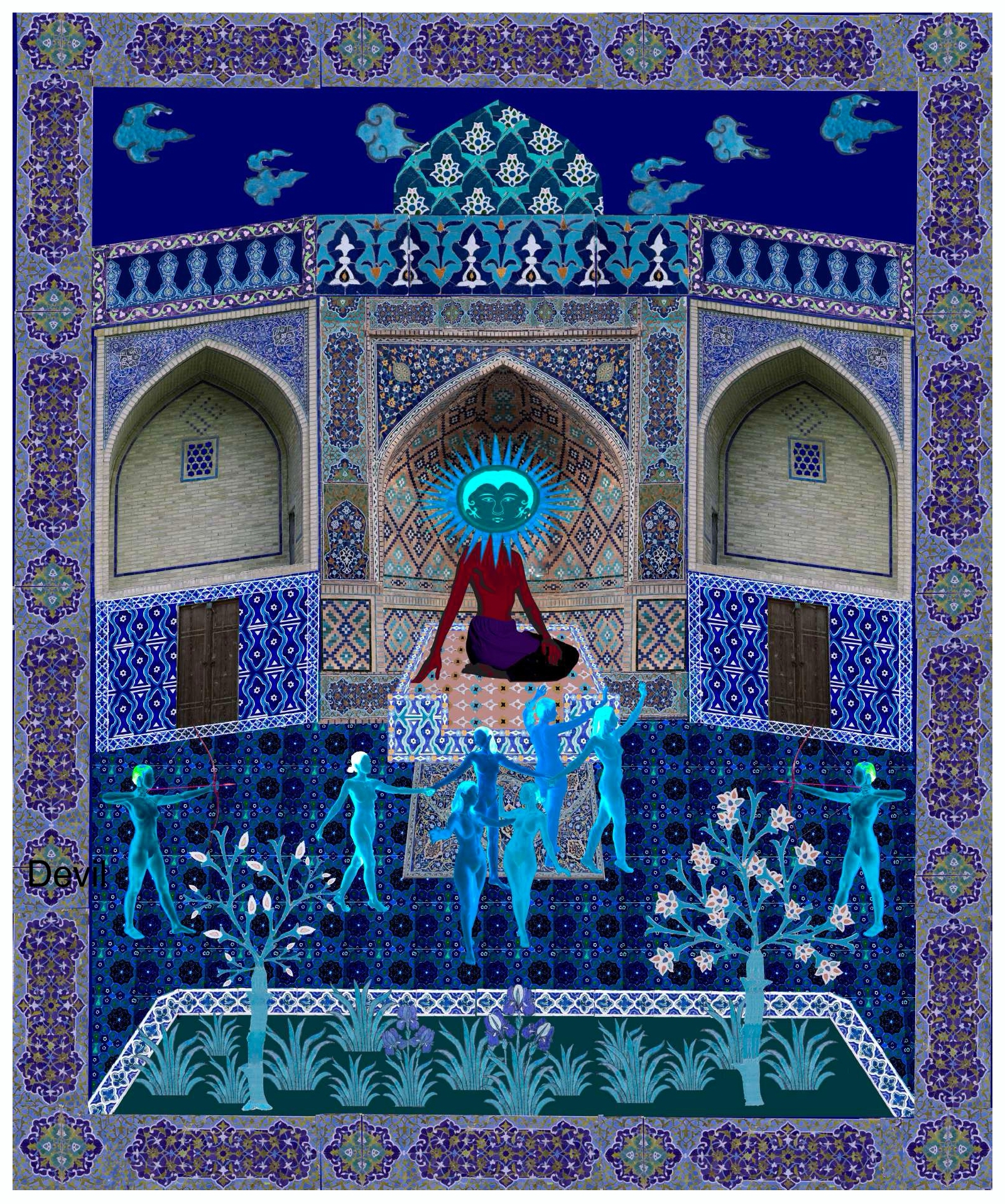
Oyjon Khayrullaeva’s practice is deeply rooted in the cultural and spiritual heritage of Central Asia. She was born in Bukhara and currently lives in Tashkent, where she draws inspiration from myths, legends, dreams, and emotional states, transforming them into contemporary visual narratives. Of particular importance are oral stories about ancient Bukhara and traditions that have gradually disappeared from everyday life, as recounted by her grandmother.
The basis of Oyjon Khayrullaeva’s artistic language lies in reinterpreting the intricate geometry of Islamic mosaic patterns and miniature paintings, which she photographs and then reworks into imaginative digital collages where mythical images are interwoven with personal and social narratives. The series Eight Lives, created for the Bukhara Biennial 2025, consists of three large tile images in blue and white depicting lungs, heart, and liver together with medicinal plants. The work is based on traditional knowledge about health and healing for women, something she learned from her grandmother. As artist-in-residence at Kin, she will devote her time to research into local knowledge of health and folk medicine.
Image 1: Rehaf Al Batniji, Shatt and Shatta
Image 2: Oyjon Khayrullaeva, The World